Three illustrated guides for running a handyman business: what you can take on without a license, insurance, flat-rate pricing, trip charges and the paperwork; finding customers, quoting, scheduling and property manager accounts; and 40 everyday jobs drawn step by step, with the time and the materials. One idea a page, each one drawn.
Real pages from all three guides. One idea a page, drawn.
The Handyman Business, Finding Customers and Running the Day, and The Job List. 129 pages, one idea each.
The idea, the picture, the costly mistake and one line to remember. Read it in the truck between jobs.
Phone-sized PDFs to check at the customer's door or in the store aisle, yours to keep. Nothing to cancel.
You know how to fix it. Nobody taught you the business.
Most of the money a new handyman business loses goes quietly: a rate copied from a friend, parts sold at cost, a favor that never made the invoice. Every one of them has a page, and every page names the mistake.
Where handyman businesses lose money:

A drawing is easier to take in between jobs than a paragraph. That's why every page in the kit has one, and one line to keep.
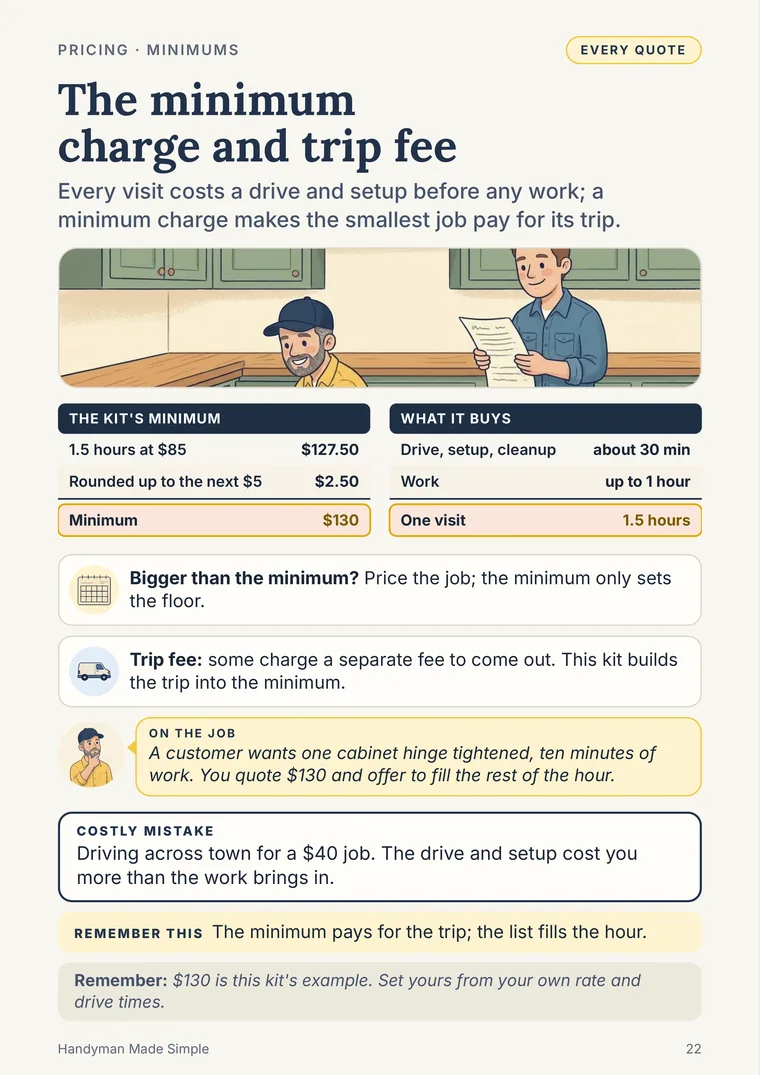
Every page has the same parts, so you always know where to look. Here is Book 1, page 22, The minimum charge and trip fee, with its lines quoted from the guide.

Every visit costs a drive and setup before any work; a minimum charge makes the smallest job pay for its trip.
A customer wants one cabinet hinge tightened, ten minutes of work. You quote $130 and offer to fill the rest of the hour.
Driving across town for a $40 job. The drive and setup cost you more than the work brings in.
The minimum pays for the trip; the list fills the hour.
Quoted word for word from Book 1, page 22, The minimum charge and trip fee. Every page carries these parts plus the drawing, and where a rule changes from state to state, a note that says so.
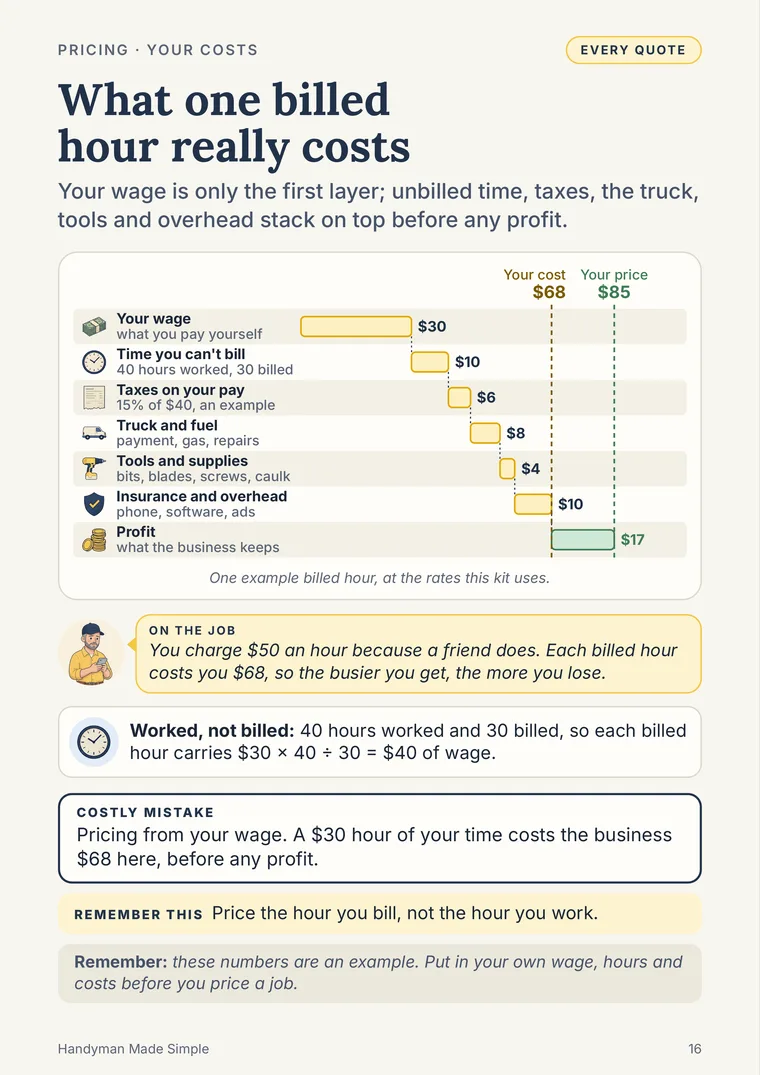
What you can take on without a license, insurance, pricing, the paperwork, money and taxes, and safety, one idea a page. Six parts: Starting out, Insurance, Pricing, Paper, Money and Safety. Start with what one billed hour really costs.
From the first call to the walk-through and the next booking, in the same layout.
The work you sell: 40 everyday jobs drawn step by step, with the time and the materials, and a check-first box on every page.
Total value: $95
One-time payment. No subscription. Keep the files forever.
Digital guides (PDF), in English. We email your library link right after purchase, and you can download the files again anytime. Plus sales tax where applicable.
Handyman Made Simple is an independent guide for people running a handyman business. It explains rules in plain words and is not legal, tax or accounting advice. It is not affiliated with any licensing board or government agency.
You can fix most things in a house; the business side is new. Book 1 lays out the setup, what you may take on without a license, the insurance and the paperwork, then what a billed hour really costs.
The calendar is full and the account is still thin. Flat rates, the minimum charge, materials markup, bundling a list into one visit and planning the week by area each get a page, worked with example numbers you can swap your own into.
Before you take on a property manager's turnovers, a realtor's repair list or your first helper, see what they expect, how to price and invoice them, and the coverage to have first, one page at a time.
No gimmicks. Public federal rules, state licensing patterns, product labels and makers' instructions, drawn clearly, with the source named on the page where it matters.
The license pages follow state contractor licensing boards; the lead paint page follows the EPA's Renovation, Repair and Painting rule; the safety pages follow OSHA's rules; the tax pages follow IRS publications; the job pages follow makers' instructions and the Consumer Product Safety Commission. Every page was checked against its named sources before release.
How big a job you can take on without a contractor license, which work needs a licensed trade, deposit limits and sales tax on handyman work all change from state to state. Those pages teach the pattern, label any state rule as an example, and point you to where yours lives.
The money pages work the same example rates all the way through: a $30 wage that costs $68 a billed hour and is priced at $85, a $130 minimum, and materials at cost plus 25%. You can see where each number comes from and swap in your own. The examples are examples, not prices for your market.
Not affiliated with or endorsed by OSHA, the EPA, the U.S. Department of Labor, the IRS, the Consumer Product Safety Commission, any state contractor licensing board or any trade association. We answer to the owner.
Use the kit for 7 days. If it isn't for you, email us and you get 100% of your money back. No fine print, no hassle.
Right after purchase we email you a link to your library, where you download all three guides as PDFs. You can come back and download them again anytime.
One-time payment of $27. No subscription, no recurring charges, and nothing to cancel. All three guides are yours to keep.
People running a handyman business in their first few years, solo or with a helper, and anyone about to turn side jobs into a business of their own.
Every state. The books teach what works the same way everywhere: pricing, insurance, customers and the jobs themselves. Where a rule changes by state, like how big a job you can take on without a contractor license, the page says so and shows you where to look up yours.
No. In nearly every state that work needs a trade license. The Job List has check-first pages for faucets, toilets, lights, fans and outlets that show what to check and when to call a licensed trade, and Book 1 shows how to sub that work out.
No. Handyman Made Simple is an independent guide for people running a handyman business. It explains rules in plain words and is not legal, tax or accounting advice. It is not affiliated with any licensing board or government agency. Your lawyer, accountant and insurance agent apply the rules to your business.
No. The kit is complete on its own.

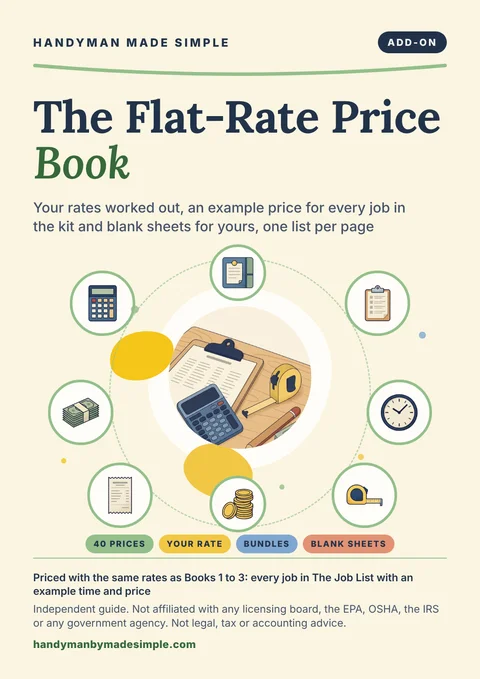
At checkout there is one optional add-on, The Flat-Rate Price Book: your hourly cost worked out with blanks for your own numbers, an example flat rate for each of the 40 jobs in The Job List, and blank sheets to price the jobs you do most. It's $7.90, unticked, and you can skip it.
Both. The pages are portrait and phone-sized, so you can check one at the job or in the store, and the PDFs print if you want a page in the truck.
We don't promise that, and we'd be wary of anyone who does. The guides show you how each piece works and the mistake that costs money, with the numbers worked on the kit's example rates. Which jobs you take and what you charge is still your call.
Email us within 7 days of purchase and we'll refund 100% of your money. Details on the refund policy page.
Spotted an error, or a rule that works differently in your state? Email info@handymanbymadesimple.com. A real person reads every message, and fixes go into the next version.
Every job with your own name on the truck teaches you something about the business side, and the expensive lessons come with a bill. You don't need another midnight group thread or a rate someone swears by. You need the page for this decision, with the idea drawn and the mistake named.